
Here are Dharshana’s takes on some of her favorite and/or recent books … from one book lover to another … just because!
All the Way to the River by Elizabeth Gilbert
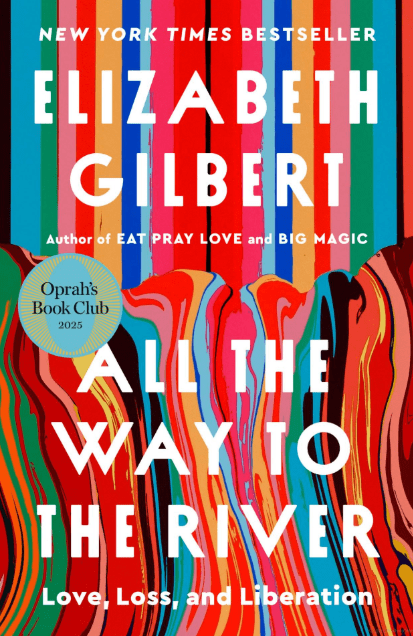
All the Way to the River is Elizabeth Gilbert in signature form, in the style we love her best—raw, brave, vulnerable, authentic, poignant, riveting. Rich with cadence and humanity, this book epitomizes the existential angst of a person living in these times, resonant to a higher degree in the American/Western context. A memoir, this book is a paean to love, loss, and liberation. In baring her soul, Gilbert holds up a mirror for the reader, inspiring introspection, stripping them of any pretense of being aboveboard, righteous, anything other than human.
Following the arc of a typical “hero’s journey,” she expounds her fall from grace, very human frailties, addictions, and deep character flaws, then unfolds for the reader’s satisfaction and edification her climb back up to sobriety, salubrity, and sanity. This book, which portrays one chapter in the author’s life, underscores that often the obstacles to our better selves are our own choices and imperfections. We are the enemy we must win over. Our own moral high ground, the land we must conquer, over and over again, and our own inner child, our first and truest responsibility.
A study on the transience of relationships, realities, and fairy tale endings, this book is a testament to the degradation, delusions, and dissonance that is now commonplace in the 21st century. Who, when reading Eat, Pray, Love with its beautiful ending to a tormented story, could have ever imagined that the heroine would throw away that happy ending as well and stride right into another tormented story? And why would anyone do that? In shedding light on her shadows and embracing them, the author makes a vital point—when the darkness becomes unbearable, when life becomes unmanageable, reach out, share your story, seek help. Because one way or another, we’re all messed up. It’s all par for the course, and it’s all OK.
Well written, with its interspersion of poetry and prose, this contemplation on the ugliness of life and how low a person can fall bringing down with them those who love them is not for everyone. Yet, it is “literature” in its truest sense and belongs up there with the likes of Hemingway, Angelou, and Dostoevsky.
Coffee with the Divine by Danét Palmer

Like A Course in Miracles, the lofty book that inspired it, Danét Palmer’s Coffee with the Divine: A Yummy Guide to Daily Miracles is a book with the power to transform your life.
A metaphysical minister by profession, Palmer has worked as an inspirational psycho-spiritual coach for several years. “Coffee with the Divine is my expression of gratitude for the grace in which I live today,” she says. Over 35 years ago, in response to a life of confusion, abuse, and anger, and to always feeling like a failure at everything, she decided things had to change. She began starting each morning in silence, communing with God, to replace her “icky” feelings of doubt, despair, dread, and desperation with the more pleasant, or “yummy,” feeling of joy, forgiveness, trust, courage, peace, and love. Soon after, as if in answer to her prayers, the book A Course In Miracles came her way. And spending time with the Divine every morning became a practice that completely transformed her life.
Directed Daily Discourse
The book A Course in Miracles (https://acim.org/acim/en) was written over a period of seven years in the 1970s by Helen Schucman, an American clinical and research psychologist, following her own decision when pushed to the edge that “things had to change.” The book came about by, as she put it, “inner dictation by Jesus Christ.” It is considered by some to be the “New Age Bible.” But, although Christian in its origins, its teachings are universal.
A Course in Miracles is a book designed to “undo the past in the present and release the future.” It essentially comprises three books: a 669-page Text, a 488-page Workbook for Students, and a 92-page Manual for Teachers. The Workbook has one lesson for each day, comprising one thought or affirmation and its explanation. The idea is to read a lesson each morning, then contemplate it intermittently, for example, once every hour, throughout one’s day and apply it to one’s life.
The introduction to the Workbook of A Course in Miracles states, “the exercises are very simple. They do not require a great deal of time, and it does not matter where you do them. They need no preparation. The training period is one year. The exercises are numbered from 1 to 365. Do not undertake to do more than one set of exercises a day.”
Thus, one day at a time, you can fully change your life. The course aims at a “thought reversal,” at “removing the blocks to the awareness of love’s presence, which is your natural inheritance.” It is a book that empowers, and among its basic premises are that “nothing real can be threatened; nothing unreal exists.”
The Daily Date with Divinity
Coffee with the Divine, published in 2020, follows the same approach as A Course in Miracles. You can read it by itself or in conjunction with A Course in Miracles. Because, as simple as it is, A Course in Miracles is heavy reading. Palmer’s Coffee with the Divine aims to convey the same truths in a lighter, more relatable way. While some books can be rushed into and may be “unputdownable,” both these books will serve their purposes most effectively when you take them slow, just reading a page or two each morning, and thinking about what you read now and then during the day, acknowledging whatever feelings and thoughts each lesson brings up.
Coffee with the Divine presents the author’s personal interpretation of the lessons of the Workbook, which she has diligently herself followed for over three decades. It is a blessing, and engaging with its ideas is a way to invite more blessings into our lives, to make our days more meaningful and joyous.
The daily lessons are meant to teach us to “let go of fear and rise in love,” via a gentle process of undoing past constructs of dealing with life. By sharing her take on the lessons, and by her example, Palmer invites each of us to transform our own lives.
“My whole way of seeing has changed,” says Palmer. “That is the miracle: A shift in perception, from fear to love. I am humble before the miracle that has become my life.”
Coffee with the Divine is peppered with several forthright instances from the author’s life and how applying these lessons helped change the situations around, miraculously as it were.
Here’s an example of how the author processes the lesson of a day:
“The door flies open. Lin and Lucas bust through, wrestling each other to the ground. I notice the temptation to be upset by the interruption, but I am aware because of my lesson practice. I breathe and apply the lesson, “I do not see a neutral child, because my thoughts about children are not neutral. I do not see a neutral interruption, because my thoughts about interruptions are not neutral.” And bingo! Everything is different. The charge that seemed to instantly get sparked as the kids burst through the door fizzled out as I applied the lesson. A big smile spreads across my face as I watch their fun. I see how my programmed thoughts make me think I have to react in a certain way. “I see no neutral things, because thoughts about things are not neutral.” I feel free. I feel present, joyful, aware. I jump into the mix with the kids, rolling around and tickle wrestling amongst the meditation pillows.”
Another example: “The receptionist at work doesn’t look at me when I greet her. The thought comes, “She’s a bitch.” I see it and apply my lesson, “I am not alone in experiencing the effects of my thoughts.” It’s not true that she’s a bitch. I let it go. She looks up. I smile. She smiles back.”
The author continues, “I see the connection between the way I think about things and what shows up in my world. I am no longer being led around by unconscious ego programming. Something extraordinary is taking place.”
Yet another example asserts that things by themselves do not have the power to upset us. It is the meanings we assign to things that determine how much power we give them to disturb us. We are therefore not as helpless as we usually think, the author emphasizes. Hence, by thinking in a fresh way, we can change what things mean for us and how they impact our mood and self-identity.
These exercises free us from the filters of the past, bringing us squarely to the present moment. And in the present moment is where healing takes place.
A Renovation of the Interiors of Our Minds
Although one can read the lessons of Coffee with the Divine randomly and still gain from them, it is better to go sequentially because most ideas build on the ones before. As one moves through the course, there is a shift in perception from seeing God as the external force and ourselves as supplicants to seeing how God resides in our minds, bodies, and souls.
As one follows the lessons, a couple of pages each day, one learns to pause and look at things objectively during the course of the rest of day as well. We realize how much of our way of responding or reacting to the events of our lives and the choices we make arise from fear. In that pause, we give ourselves the power to choose again, wisely this time, so that we can consciously choose love over fear, faith over distress, and peace over anger.
The book makes one question one’s assumptions and habits of thinking and being. This dialogue with oneself and distancing from the ego leads to heightened awareness, and a greater communion with the divine.
With these lessons and exercises, “We are being guided on a direct path which uncovers the happiness God wills for us.”
Of course, the ego may resist some of the lessons, especially over the first few months. What is important is to keep doing the exercises anyway. As you do, you will realize that the ego is a very limited and limiting concept. It keeps us small and separate from all. Doing the exercises makes one not only realize but experience and live through a heightened state of awareness, with love for all, and anchored in the present. Eventually, well into the course, one will experience a yanking of one’s ego, a dive into the stillness and love within, and a deep transformation of one’s “story of me,” as the author calls it.
Hence, this is a very important, beautiful, meaningful book. Reading it could probably be one of the best decisions of anyone’s life.
A Guide to An Enlightened Life
One of the basic premises of the book, as Palmer states, is “that any problem we are having, regardless of the form it takes, is not our real problem. Our real problem is that we believe we are separate from God. This is our one and only problem. It is not true—and it never actually occurred.”
Over the course of a lifetime, we have been programmed to react to things in certain ways, this book is like a reset button. It reinforces the concept of Oneness and asserts that “everything we think is affecting every mind … every thought affects the whole perception of the world. Every thought we have contributes either to truth or illusion, unity or separation, love or fear. We are alone in nothing.”
Like all spiritual journeys, Coffee with the Divine, too, opens us up to the idea of Oneness, to the reality that we are deeply interconnected with every other person and thing.
We are all in this together. Hence, if even a few of us pick up this book and sincerely follow up on the daily exercises, we will be bringing light to all of us.
As for those who like to take things with a pinch of salt, whether one accepts or resists the books lessons, reading them will definitely prove a starting point to finding our way back to the inner wisdom that has always been ours. And to being the miracle the course intends for us to be.
 dharshana Bajaj